


Article: 13 May 2025 14:45: Care,clients,Cuviva´s offering,Digital Therapies,Partnership
Sundsvall Municipality – Remote Platform
Sundsvall Municipality’s investment in Cuviva as a remote care platform
1. Contract decision and digital strategy
In February 2025, Sundsvall Municipality signed a groundbreaking agreement with Cuviva to deliver digital health and care services. The platform is intended to support the municipality’s strategy for person-centered care by enabling automation, integration, and IoT technology. The aim is to improve care quality, free up time, strengthen the work environment, and increase citizens’ access to healthcare (Mynewsdesk).
2. Technical overview of the platform
Cuviva is an open communication platform designed for care, support, and home-based services. It combines a variety of sensors and apps, and is both user-friendly and resource-efficient.
3. Digital support within individual assistance (LSS and housing support)
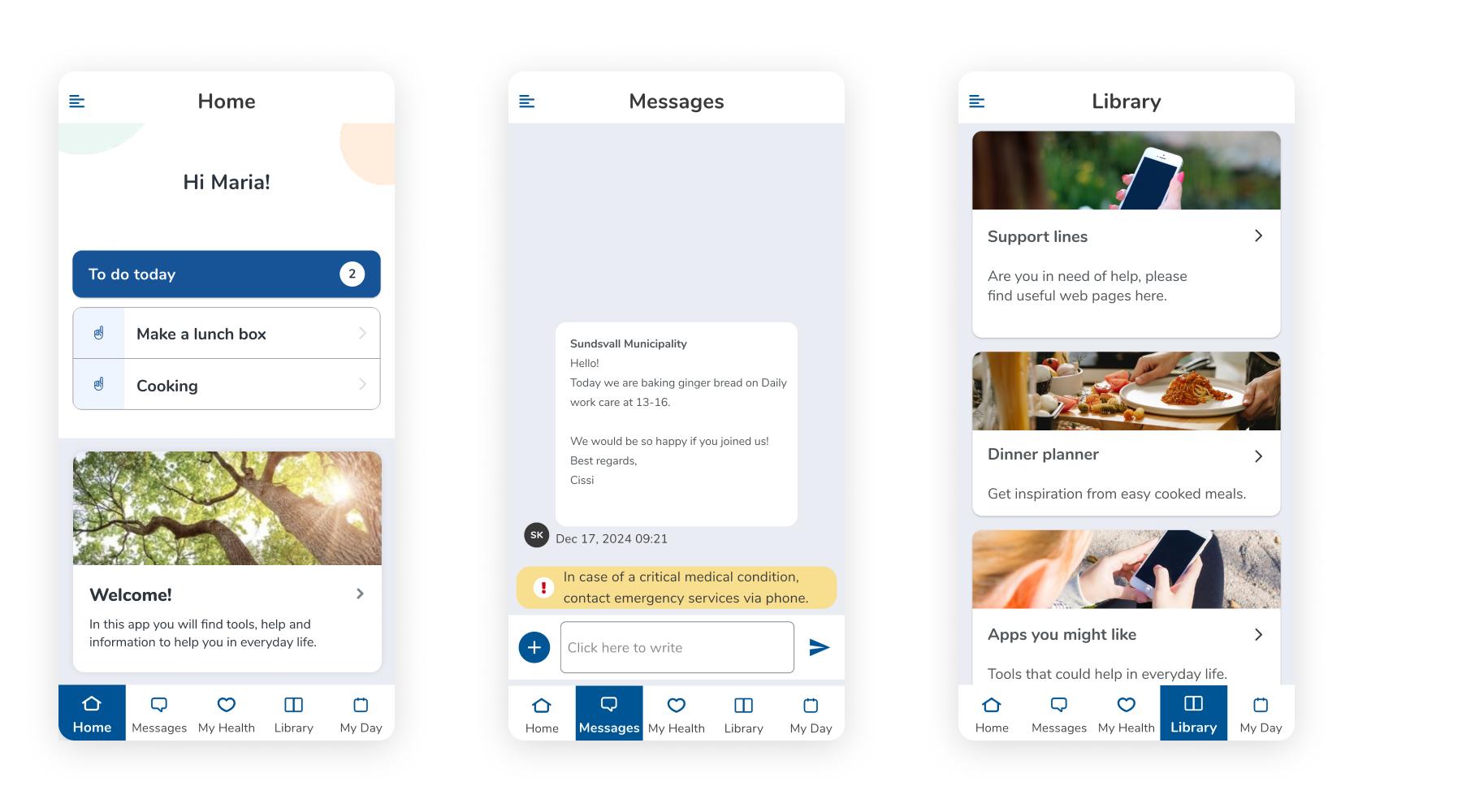
Sundsvall Municipality, in collaboration with Cuviva, has developed a solution within the Individual Support unit to provide digital support in daily life – as a complement to physical contacts, with the aim of increasing independence and reaching more people with the same resources. In practice, this means that the housing support worker plans tasks for the user in Cuviva, which are then displayed in the mobile app. The app offers chat, video meetings, and task notifications, and is used for joint follow-up – both digitally and during physical visits.
4. Results and benefits
Sundsvall Municipality reports that the platform contributes to:
- Increased independence for users.
- Freed-up time for staff, as digital measures complement physical meetings.
5. User-friendly app for citizens
Citizens receiving support from the municipality use a dedicated Cuviva app, which presents tasks and enables contact with staff via chat or video call. The app sends reminders to answer questions, exercise, or participate in meetings.
Summary
Sundsvall Municipality has integrated the Cuviva platform as a central part of its digital health and care strategy. The platform supports:
- Individually tailored home care, primarily for the elderly and people with multiple chronic conditions.
- A digital transition where the user receives planned tasks and communication channels via a mobile app.
- More efficient resource management by freeing up staff time and strengthening user independence.
Example of an application within Digital Housing Support in Sundsvall Municipality
For the approximately 250 people (clients) who live in their own homes and are granted individual support, different types of assistance are provided. This support is delivered by housing support workers and may include help with structure and planning in daily life, for example with shopping, cleaning, laundry, and contact with authorities. The support is provided through physical visits, by telephone, or digitally, and the Individual Support unit has assessed that there is potential to provide even more digital support.
Based on the goals and expected benefits of digital support, the Individual Support unit has developed a solution using Cuviva’s functions for checklists with tasks and reminders, an information library, and communication via chat and video meetings.
In practice, the housing support worker creates an individualized plan with the client, where agreed tasks are entered into the platform (and linked to the client). The client can then use the mobile app to view and manage their personal tasks. Afterwards, the housing support worker and client can follow up on progress together, either through digital communication, physical meetings, or by phone. How this works in reality may vary between different housing support workers and clients depending on needs.
The housing support workers’ starting point has been to use the mobile app/platform during each client’s scheduled support time. However, the individual’s tailored planning with tasks and reminders in the mobile app means that support is indirectly available around the clock (depending on the client’s needs).
Documented benefits
- Increased independence for clients,
- Freed-up time for staff,
- Clients start and complete more activities without the housing support worker being present in the home,
- Clients can see their progress,
- Clients receive feedback on completed activities,
- Clients know what needs to be done today,
- Housing support workers provide individualized assistance.